FAssets brings assets like XRP into DeFi through a collateralized, rule-based architecture. Version 1.3 updates that architecture with a more direct minting path, simpler routing into FXRP, clearer controls around mint execution and flow, and a design that moves FAssets closer to its longer-term direction. Recent bridge incidents have made these design questions more visible across the market. That makes this a good time to explain how FAssets works today, what changes in v1.3, and where those changes sit within the broader system.
FAssets today
Minted FAssets are backed by agent-posted collateral locked in smart contracts.
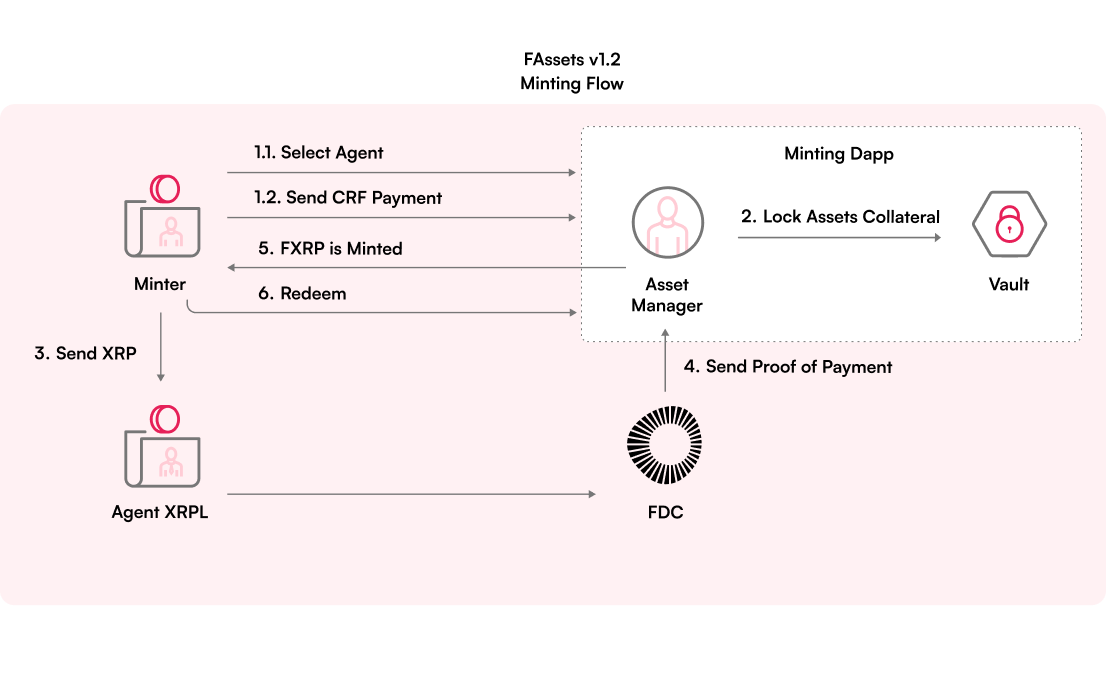
Positions are monitored against the required Collateral Ratio (CR), challenged with proofs when violations occur, and supported by graduated emergency controls.
The protocol continuously measures each position against its required collateral ratio. If a position becomes unhealthy, liquidation can begin immediately by anyone.
The system also distinguishes between market-driven deterioration and protocol violations. Undercollateralization is handled through unhealthy-position liquidation. Non-permitted payments and similar violations can be challenged with FDC proofs and pushed into full liquidation.
Governance also has emergency controls with different scopes, so the protocol can respond proportionally rather than relying on a single binary shutdown.
What changes in v1.3
V1.3 sits between the current FAssets system and the later v2 architecture. It was already on the roadmap, but recent market events have made it more important to explain how the minting path is being updated.
The main change is in minting.
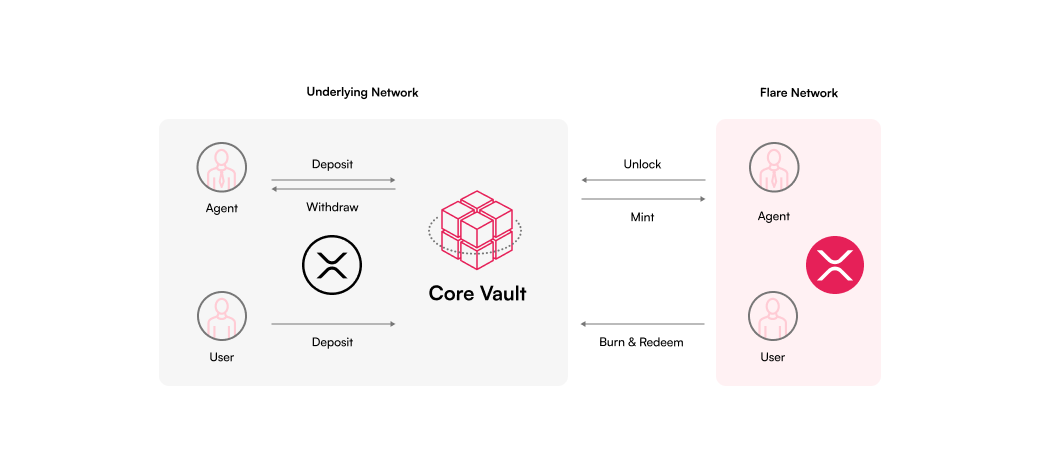
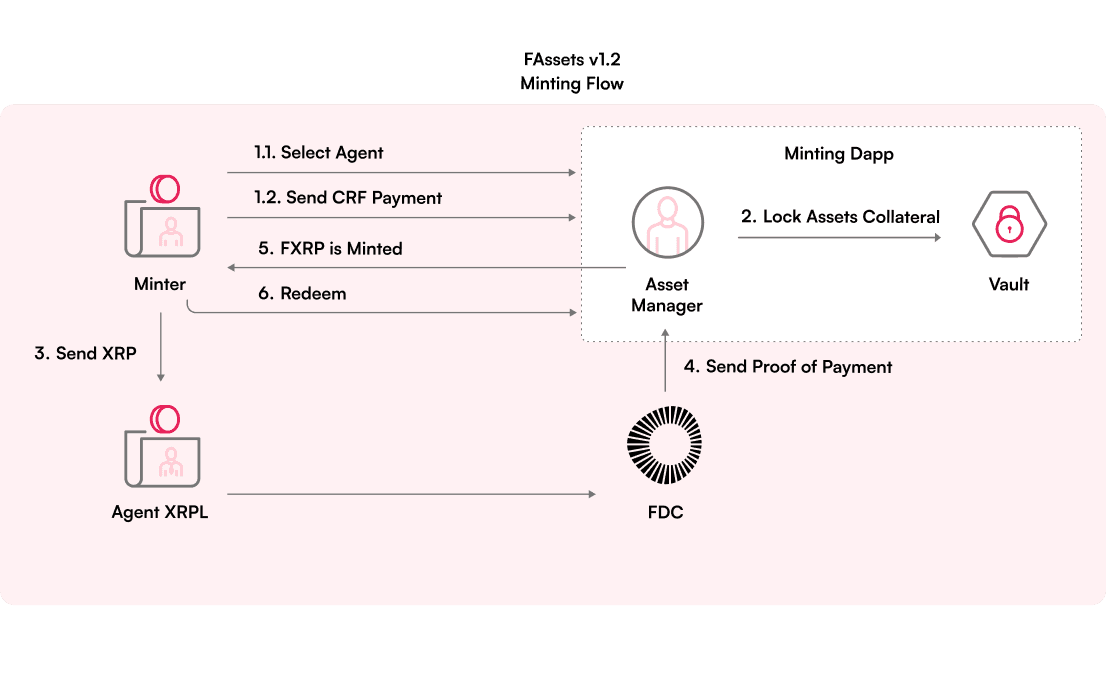
In the current model, minting is tied to a chosen agent. In v1.3, users initiate minting by sending XRP to the core vault on XRPL, and an executor relays the proof to Flare to complete the mint.
That makes the minting path more direct. It removes mint-side bottlenecks tied to agent capacity, simplifies routing, and moves the system toward an architecture that can support broader access over time.
Agents remain essential on redemption, and the collateralized redemption model stays in place.
What v1.3 adds
A more direct minting path also requires clearer execution controls. V1.3 adds mechanisms around who can complete a mint, how mint proofs are used, and how larger flows are handled.
These include:
- Executor restrictions: v1.3 can limit who is allowed to complete a minting flow, depending on how that mint is initiated.
- Proof-use binding: The proof flow can specify who is permitted to present the proof, narrowing the scope for misuse around execution.
- Hourly mint limits: Mint volume is capped over shorter time windows to moderate sudden spikes.
- Daily mint limits: Broader daily caps help keep total system exposure within defined bounds.
Large-mint thresholds: Mintings above a defined size are treated differently from ordinary flow. - Automatic delays for large mintings: Larger mintings are delayed rather than processed immediately through the normal fast path.
These mechanisms make the minting path more scalable in normal operation while keeping execution and flow governed by explicit rules as activity grows.
Version 1.3 also matters beyond this release. A more direct minting path and clearer execution controls move FAssets toward a cleaner architecture for broader adoption.
That makes XRPFi easier to access through the channels users already trust, while keeping the protocol’s rules explicit as the system scales.
FAssets (FXRP) and FXRP OFT
Core FXRP / FAssets functionality on Flare is separate from FXRP’s OFT route.
The OFT route handles cross-network transfers, moving FXRP between Flare and other supported networks such as Base, HyperEVM, HyperCore and Monad. FAssets is the collateralized asset system on Flare, including minting, redemption, liquidation, collateral enforcement, and the changes introduced in v1.3.
That is why the recent OFT pause applied to cross-network transfers, not to core FAssets functionality on Flare.
Flare has also updated the FXRP OFT route separately. As reflected in the Flare Developer Hub, FXRP OFT routes are supported by four DVNs: LayerZero Labs, Nethermind, Canary, and Horizen. That work sits alongside the architectural changes introduced in FAssets v1.3.
Bridges still matter
Bridges still matter because liquidity, demand, and execution are distributed across networks. The question is not whether cross-chain systems should exist, but what kind of architecture they run on.
FAssets v1.3 moves that architecture forward with a more direct minting path, clearer execution controls, and better-defined handling for larger flows. That makes XRPFi easier to access without loosening the rules that hold the system together.
V1.3 will launch on Songbird first,continuing Flare’s practice of using its canary network as a live proving ground for protocol upgrades before mainnet deployment.
Why this matters
Practical context for the Flare ecosystem.
For users
Simpler minting flow – users send XRP to a known vault and wait for proof confirmation, potentially faster and with fewer intermediary steps. Limits on mint volume protect against sudden spikes but may introduce waiting periods for large requests.
For builders
Need to integrate executor logic, handle proof‑use binding, and respect mint caps. Monitoring tools must track hourly/daily limits and large‑mint delay queues. Redemption paths unchanged but still require agent interaction.
For the network
Reduces reliance on agent capacity for minting, which could lower congestion on the collateral contracts. New caps and executor restrictions aim to keep system exposure within defined bounds, aiding stability as traffic grows.
FTSOBest analysis
Current FAssets design (pre‑v1.3)
- Collateral model: Agents lock collateral in smart contracts. Each position is continuously checked against a required Collateral Ratio (CR).
- Liquidation: Unhealthy positions can be liquidated by anyone; protocol violations can be challenged with FDC proofs and forced into full liquidation.
- Emergency controls: Governance can trigger scoped emergency actions instead of a binary shutdown.
What v1.3 changes
- Mint initiation
- Prior behavior: User selects an agent; the agent handles the XRP deposit and minting.
- v1.3 behavior: User sends XRP directly to a core vault on the XRPL. An executor relays a proof to Flare to finalize the mint.
- Agent role
- Prior behavior: Needed for both minting and redemption.
- v1.3 behavior: Required only for redemption; minting no longer depends on agent capacity.
- Execution control
- Prior behavior: Open mint execution (any agent could complete a mint).
- v1.3 behavior: Executor restrictions allow the protocol to limit which executors may complete a given mint.
- Proof handling
- Prior behavior: Proofs were generic; any holder could present them.
- v1.3 behavior: Proof‑use binding ties a proof to a specific executor, reducing misuse risk.
- Rate limits
- Prior behavior: None documented in the source.
- v1.3 behavior: • Hourly mint limit – caps total mint volume per hour.• Daily mint limit – caps total mint volume per day.• Large‑mint threshold – mints above a size are treated specially.
- Large mint handling
- Prior behavior: Processed immediately.
- v1.3 behavior: Automatic delays for large mints, moving them out of the fast path.
Why the changes matter
- Direct path reduces a potential bottleneck: the mint step no longer depends on an agent’s capacity, which can improve throughput as demand for FXRP grows.
- Explicit controls give the protocol tighter governance over mint volume and execution, helping keep exposure within safe limits.
- Scalability: Hourly/daily caps and delayed large‑mint processing aim to prevent sudden spikes that could stress collateral pools or oracle feeds.
- Separation from OFT: The core FXRP mint/redemption logic is independent from the OFT bridge that moves FXRP across networks. The recent OFT pause only affected cross‑chain transfers, not the underlying FAssets contracts.
Interaction with other components
- FXRP OFT – Supported by four DVNs (LayerZero Labs, Nethermind, Canary, Horizen) for cross‑network transfers. The OFT route continues to evolve alongside v1.3 but is not directly impacted by the minting redesign.
- Songbird launch – v1.3 will be deployed on the canary network first, following Flare’s practice of live testing upgrades before mainnet activation.
Practical considerations for stakeholders
- Users will see a single‑step deposit to the XRPL vault, but must be aware of the new rate limits. Large requests may experience a short delay.
- Builders/developers need to:
- Implement executor selection logic and proof‑binding verification.
- Query on‑chain state for current hour/day mint totals.
- Handle delayed large‑mint flows (e.g., UI notifications, queue status).
- Infrastructure operators should monitor:
- Collateral ratios for agents handling redemption.
- Mint volume metrics to ensure limits are enforced.
- Execution logs for proof submission to detect any unauthorized attempts.
All facts are taken directly from the Flare Network announcement. Interpretations reflect technical reasoning and are not promises of future performance.
Ratings
Comments
Connect your wallet to leave a comment.