XRPL settles XRP. Flare gives it a programmable financial layer. XRPFi is the first major proof of that architecture. A year in, XRP is not just programmable on Flare. It is working capital.
A year ago, XRP did one thing, and did it better than almost anything else. It moved. XRPL was built to issue and settle values at scale. What XRPL was not built to do is program that value. On 24 September 2025, FAssets went live on Flare mainnet with FXRP. The week-one mint cap was 5 million FXRP and it filled in about four hours. Every raise after that filled too.
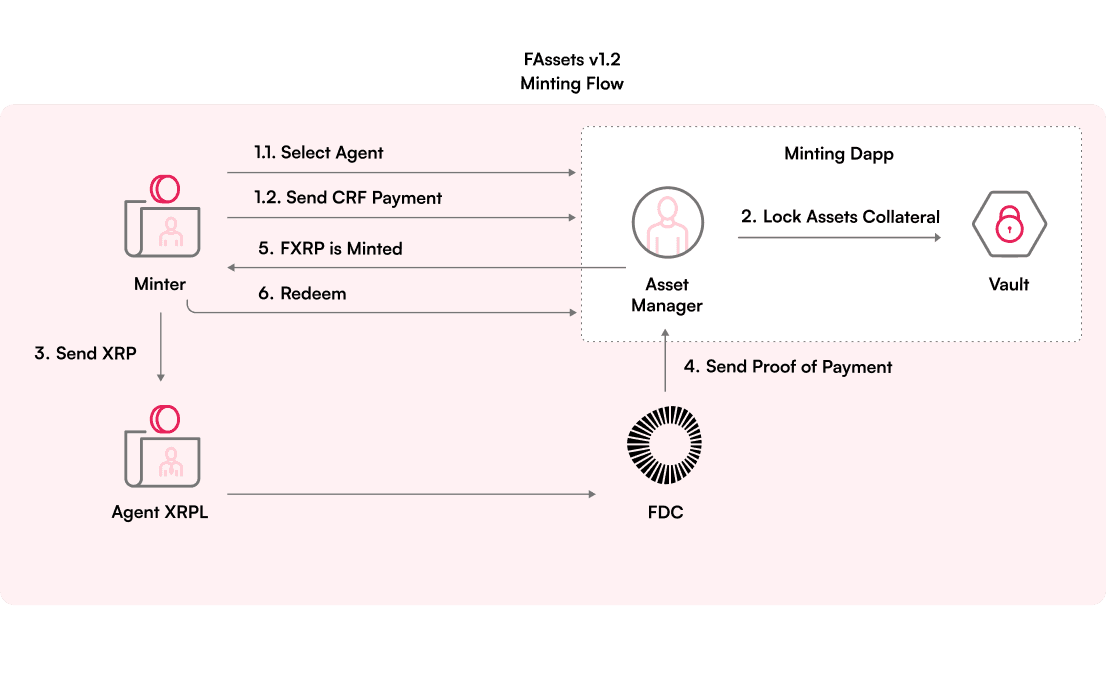
It is tempting to look back and call that the launch of a token. It was not. FXRP is the mechanism that makes XRP programmable: a 1:1 representation minted only after Flare's data protocols verify the payment on XRPL, backed by an overcollateralized system of independent agents. The XRP backing it stays on XRPL. It sits in the Core Vault, acting only on instructions from Flare's smart contracts, with excess XRP time-locked in native XRPL escrows that release one batch per day.
XRPL settles XRP. Flare gives it a programmable financial layer. XRPFi is the first major proof of that architecture.
A year in, XRP is not just programmable on Flare. It is working capital.
From programmable to working capital
Programmable was step one. On its own it means the asset can be used by a smart contract — necessary, but nothing a holder can feel.
Working capital is the part that matters. FXRP is lent and borrowed. It is posted as collateral. It backs a stablecoin through Enosys CDP. It sits in vaults that deploy it across strategies and compound the returns back into XRP. The asset earns instead of sitting idle.
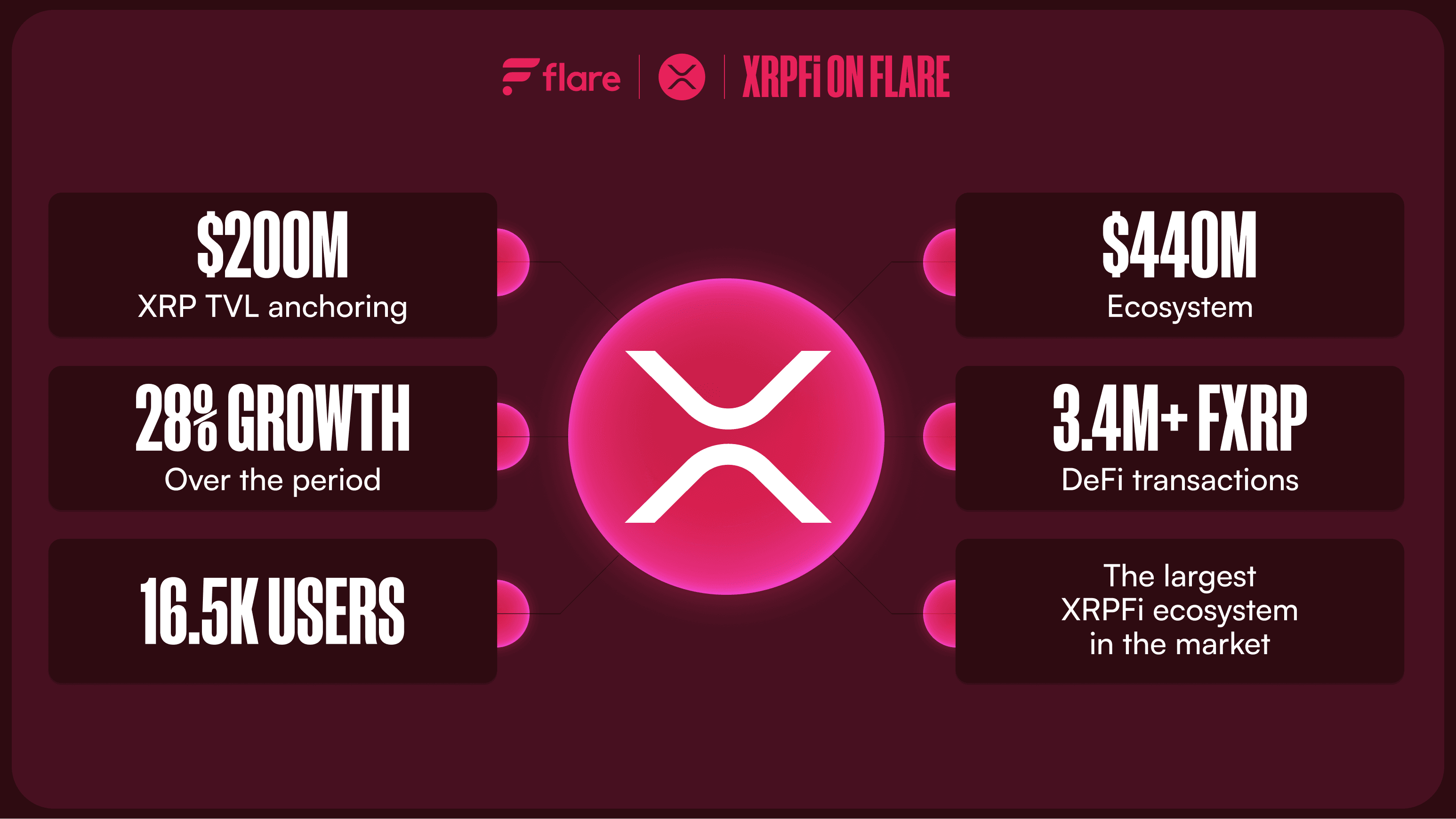
The numbers moved in that order, not the other way around. 90M+ FXRP minted by the end of January, roughly 80% of it deployed into DeFi rather than sitting in wallets. More than 155M minted by late April. FXRP in DeFi grew from 82M to 144M between February and July. What changed in that period was not the technology — it shipped earlier. It was holders working out that idle XRP was a missed opportunity, and that they could earn on it while keeping full exposure to the asset they wanted to hold anyway. As of today, ~ 145.2M FXRP minted with 130M FXRP in DeFi at work across ~7.8M transactions. ~21M FXRP is sitting on other chains via OFT, that is 14.4% of the 145.2M outstanding.
The share deployed is the interesting figure. It is the difference between a wrapper people hold and capital people use.
A vault was never just a vault
There is a pattern across this year that becomes clear in hindsight. Each launch was announced on its own terms, framed to make that one product easy to understand. Read one at a time, they look like a list. Read in order, they are a single build.
Everything shipped over the last twelve months was a deliberate play into a planned stack.
Take the vaults. They were built to make earning on XRP simple — consolidating strategies into a single deposit, with professional risk curators running them rather than the holder managing positions themselves. They did that job. They were also foundational for something we had not announced yet. A vault is unreachable at scale if every XRP holder has to become an EVM user first: new wallet, gas token, manual mint. So while the vaults were shipping, Flare Smart Accounts were already being built to connect them to the XRPL wallets people already had. Most people did not know that work existed. The vaults still had to come first.
The vaults still had to come first. When the door finally opened in Xaman, more than 20M XRP went straight into vaults and DeFi in under a week — a year of groundwork, collected in a few days.
Mid-May is the clearest example of the sequencing. FAssets v1.3 reached mainnet, the first FIP.16 emissions cut executed, and a second managed vault went live, all in the same week. Rails, economics and product — three layers of one system, arriving together.
How it got built
A secure rail. FAssets shipped with four independent audits from firms including Zellic and Coinspect, an Immunefi bug bounty, community review through Code4rena, and 24/7 monitoring from Hypernative. Minting and redemption are enforced by collateral and proofs. Security is an ongoing commitment, not a launch milestone — the system handles trust-minimized bridging and collateral management, where the cost of being wrong is absolute.
An ecosystem around it. FXRP is only useful if there is somewhere to put it, so the markets came next: lending and isolated markets on Kinetic, liquidity on SparkDEX, BlazeSwap and Enosys. Then, in a single month at the end of 2025, four primitives:
- Firelight — the first staking layer for XRP. Deposit XRP, mint FXRP, stake it, and hold stXRP: a liquid position that stays composable across Flare while it accrues. Its next phase turns that staked capital into DeFi cover, backing protocols against smart-contract exploits.
- Spectra — fixed rates and yield trading. Yield-bearing positions split into principal and yield, so a holder can lock a fixed return or trade the variable part.
- earnXRP — the first fully on-chain XRP-denominated yield vault, built on Upshift's vault infrastructure and curated by Clearstar, an on-chain risk manager. One FXRP deposit is deployed across strategies and compounded back into XRP.
- Enosys CDP — FXRP as collateral to mint an XRP-backed stablecoin, supported by an rFLR-incentivized stability pool.
- Kinetic — lending markets for FXRP, including an isolated pool so risk stayed contained while the asset was new. Borrowing against XRP instead of selling it is the primitive everything else leans on, and it is the one now being pulled into the one-signature path.
Then the door. From February, holders could reach those vaults from the XRPL wallet they already used: Xaman first, then D'CENT for hardware. FAssets v1.3 reshaped minting into something venues already run at scale — a single XRPL payment with a destination tag, no agent selection, no collateral reservation — and Hex Trust brought the same flow inside regulated custody. By July, Flare Smart Accounts v1.3 had collapsed the path into one XRPL signature across five wallet connections, with nearly 24,000 smart accounts created and more than 40M XRP earning through Xaman and D'CENT alone.
No layer here is finished. Flare Smart Accounts keep gaining capabilities and partners; vaults are one application of that infrastructure, and loan origination will be another. This is the next phase of the same system, not a new one.
None of it was built by Flare alone. Flare has worked as a field to incubate: teams used FXRP as their first proof and built real products on top of it. Clearstar's vault holds over 32M FXRP in deposits. Firelight uses FXRP to build onchain cover, making staked XRP the capital that backs other DeFi protocols against exploits, oracle failure and bad debt. Those teams are part of this network now, and it is part of them.
The last half year, regardless of the market
Three things were completed in the last 6 months, none of them dependent on the market all pursuing the same direction. Better and more connected - or something nice here. FXRP went cross-chain. XRP as collateral in EVM DeFi is no longer a Flare-only story. Through LayerZero's OFT standard, FXRP now reaches Ethereum, Base, BNB Smart Chain, Monad, Katana, HyperEVM and HyperCore, bridgeable through Stargate and verified by four independent DVNs — LayerZero Labs, Nethermind, Canary and Horizen. Native transfers, not wrapped copies, always backed by FAssets and anchored to XRPL.
Credit arrived on top of existing liquidity. In August, FXRP went live as collateral in Sentora's RLUSD vault on Morpho, on Ethereum mainnet. Supply FXRP, borrow RLUSD, keep the exposure. Caps have been scaling with demand since. Caps have been scaling with demand since: the market opened at a $4M cap and stood at $7.85M with $7.9M RLUSD supplied against 10.6M FXRP collateral as of today.
The menu matured. One vault is a product. Several vaults with different risk profiles is a market. Clearstar for fully on-chain and verifiable. Monarq for managed, multi-strategy exposure. Firelight for staking. Derive for options and perps with FXRP as collateral.These are actively managed strategies, not fixed-rate savings products — returns move week over week. Firelight sits at the other end: staking, with a rate that stays close to fixed rather than tracking a strategy. Holders now choose the profile instead of taking the only option available.
The pattern, once you line it up
Read the year in sequence and each piece is standing on the one before it.
The secure rail made markets possible. The markets made vaults worth building. The vaults made Flare Smart Accounts necessary, because strategies only count if the people holding the asset can reach it.Direct minting was built so that exchanges and custodians could integrate at all, since their withdrawal systems speak destination tags, not smart-contract calls. Also to make this easier and faster. Cross-chain FXRP was built so that collateral could reach credit markets that were already deep. And the RLUSD market on Morpho is what makes the next step obvious: bring that borrow into the same one-signature path the vaults already use.
Underneath all of it sit the same two enshrined protocols. FDC proves the XRPL payment. FTSO prices the collateral. They are built into Flare's consensus rather than bolted on, which is why this sequence can exist here and is difficult to copy elsewhere.
That last point is the one worth carrying forward. None of what happened this year was an XRP feature. It was what happens when verified data is part of a chain rather than an add-on to it. XRP is the asset that proved it first, and the largest, but the foundation underneath was never asset-specific.
Still ahead: XRPL, end to end
The honest part of an anniversary is what is still open.
Today the most useful flows in XRPFi begin on Flare. The next version begins and ends where XRP already lives: sign from your XRPL wallet, borrow RLUSD against your XRP, and have it delivered back to your XRPL address or directly to an exchange or bank deposit address. Same pattern as the vaults — the market gets built first, the XRPL-native path is the block that comes next. That is the direction of travel: deeper alignment with XRPL itself, not XRPL as somewhere assets are imported from.
Looking forward: the watch list is Flare, not the next ticker
What year one proved is that value stranded on a non-smart-contract chain can become working capital, safely, and that people will use it when the path is simplified.. The question worth asking is what else can run inside it.
Tokenisation pulls hardest on that. XRPL is becoming a serious venue for issuing real-world assets, and its native tools handle the issuance side well: fast settlement, low fees, and compliance controls institutions recognise. Assets are arriving. The open question is what they can do once issued.
The requirements at that layer are stricter than the ones onchain finance has met so far. A tokenised treasury book or FX position carries information that moves markets before it settles, so the underlying data has to stay confidential. Confidentiality on its own is not sufficient. Institutional participants also require verifiable evidence that reserves and calculations are correct, which is the opposite requirement. To date those two have largely been a trade-off.
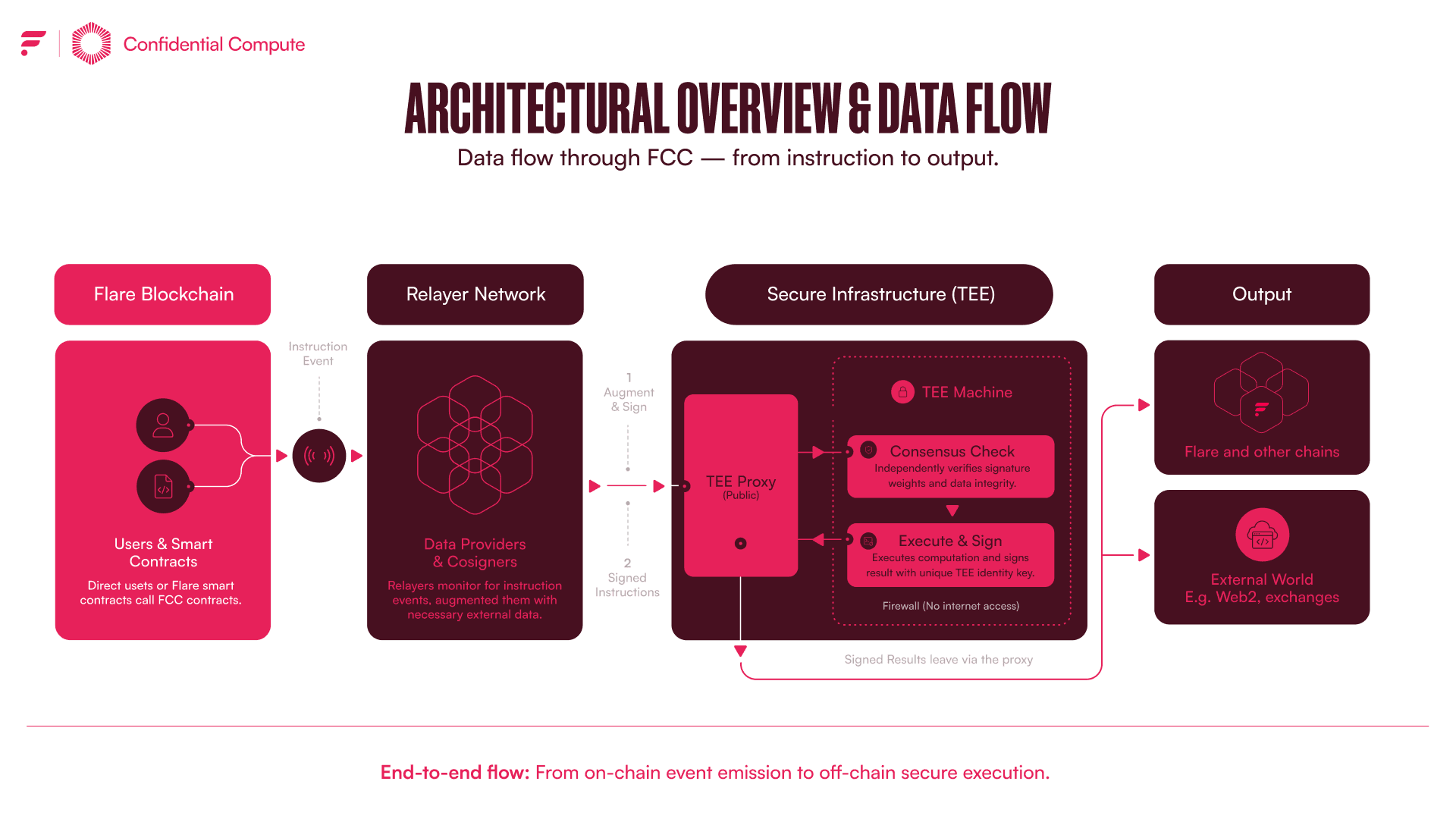
That is the gap Flare Confidential Compute is built to close. Execution happens in hardware-secured environments, authorized by the same data provider consensus that secures the oracle layer, so data and compute share one security model. Confidentiality that begins from verified inputs rather than confidentiality taken on faith.
That is the same shape as the last 12 months. Assets are issued where they were always going to be issued, and Flare is where they do more. FCC arrives on Songbird first, our canary network, the same way FAssets did.
How this reaches FLR
All of it is mapped to reach the token. That is a design, and FIP.16 is where it was written down.
FIP.16 cut annual FLR inflation from 5% to 3%. It also directed the real, recurring fees at FIRE, whose first mandate is supply reduction through buybacks and burns, alongside its other allocations under governance. Routing today: FAssets minting fees, FXRP destination-tag fees, the FDC share, and the redemption slice.
Worth being precise about what that means. Not every FXRP trade or loan sends revenue to Flare. Specific events do: a mint, a tagged payment, an FDC attestation, a redemption. Other sources — more of the Smart Accounts path, FCC later — are designed and staged rather than live, and we are not going to describe them as if they are already flowing.
The figure is gradually scaling and public: $44,632 is cumulatively in FIRE. The mechanism is on. What comes next is volume, which is exactly what closing the XRPL path and reaching holders inside the venues they already use is built to produce.
What we can offer is the board. FLR secures the data layer. FIRE is where activity can pay it.
One year in
XRP became programmable. Then it went to work. Then the ways to use it matured, and the path shortened to a single signature.
The next year gets built the way this one was built: each piece aimed at the next one.
If you are already using FXRP, you have been holding one part of this. If you are not, the wallet you already have is enough to start.
Flare is the blockchain for data. XRPFi is what that made possible first.
Start at https://fsa.flare.network/vaults and explore all live XRPFi opportunities here.
Why this matters
Practical context for the Flare ecosystem.
For users
FXRP lets XRP holders earn yield, borrow against their XRP, and access multi‑chain DeFi without moving the underlying XRP off‑chain. The one‑signature path via Flare Smart Accounts simplifies interaction from existing XRPL wallets.
For builders
Developers gained a secure, over‑collateralised bridge (FAssets) and a suite of primitives (vaults, staking, CDPs, lending markets). The modular stack encourages new products—e.g., on‑chain cover, options, or confidential compute—without rebuilding the data‑verification layer.
For the network
Flare’s consensus‑integrated FDC and FTSO enable trust‑minimized bridging and pricing, supporting a growing FXRP economy that contributes fees to the FIRE fund and demonstrates Flare’s utility as a data‑layer blockchain.
FTSOBest analysis
1. What FXRP is and how it works
- Tokenisation model – FXRP is minted 1:1 to XRP that remains on the XRPL Core Vault. Minting only occurs after Flare’s data protocols (FDC) confirm a destination‑tagged payment on XRPL.
- Collateral & over‑collateralisation – Independent agents provide collateral that backs the minting process; excess XRP is time‑locked in native XRPL escrows, releasing one batch per day.
- Programmable layer – Once minted, FXRP can be used by Flare smart contracts, opening the XRP asset to DeFi primitives that were impossible on the XRPL alone.
2. Deployment milestones (Sept 2025 – Sep 2026)
- Launch
- Key fact: FAssets with FXRP went live on 24 Sept 2025; week‑one cap of 5 M FXRP filled in ~4 h.
- Mint volume
- Key fact: ~145.2 M FXRP minted to date; ~130 M (≈90 %) deployed in DeFi.
- Transactions
- Key fact: ~7.8 M FXRP‑related transactions recorded.
- Cross‑chain
- Key fact: FXRP bridged via LayerZero OFT to Ethereum, Base, BNB Smart Chain, Monad, Katana, HyperEVM, HyperCore (verified by 4 DVNs).
- Market primitives
- Key fact: Firelight (staking), Spectra (fixed‑rate/yield trading), earnXRP (on‑chain yield vault), Enosys CDP (stablecoin collateral), Kinetic (lending markets).
- Smart Accounts
- Key fact: By July 2026, ~24 k Flare Smart Accounts created, enabling a single XRPL signature across five wallet integrations (Xaman, D'CENT, etc.).
- Fee collection
- Key fact: Minting, destination‑tag payments, FDC attestations and redemptions feed the FIRE fund (≈$44.6 k to date).
3. Building blocks and their dependencies
- Secure rail (FAssets) – Audited by Zellic, Coinspect, Code4rena; bug‑bounty on Immunefi; 24/7 monitoring by Hypernative. Guarantees trust‑minimized bridging and collateral enforcement.
- Liquidity & market layer – Kinetic lending, SparkDEX, BlazeSwap, Enosys provide the venues where FXRP can be lent, borrowed, or used as collateral.
- Vaults – Aggregate strategies, managed by professional curators (e.g., Clearstar's 32 M FXRP), making earning on XRP simple for users who prefer not to manage positions directly.
- Flare Smart Accounts – Abstract the need for an EVM wallet; they let XRPL users interact with DeFi using their existing XRPL keys and a single signature.
- Cross‑chain bridge – LayerZero OFT ensures native FXRP transfers (not wrapped copies) across EVM chains, expanding the pool of collateral‑accepting protocols.
- Revenue loop (FIRE) – Fees from mint/redemption and data attestations are routed to a burn‑and‑buy‑back fund as defined in FIP‑16, aligning economic incentives with FLR tokenomics.
4. Technical interpretation
- Data verification as protocol‑level consensus – By embedding FDC (payment verification) and FTSO (price feeds) into Flare’s consensus, the system avoids the “oracle‑as‑add‑on” risk, making the bridge resistant to external manipulation.
- Over‑collateralisation model – Independent agents post collateral greater than the escrowed XRP value. This design mitigates the risk of under‑collateralisation during market stress, but requires continuous monitoring of agent solvency.
- One‑signature UX – Flare Smart Accounts map a single XRPL transaction (destination tag) to multiple downstream actions (mint, deposit, borrow). This drastically reduces friction for retail holders and custodians.
- Cross‑chain security – LayerZero’s OFT uses decentralized verification nodes (DVNs) to attest the authenticity of FXRP transfers. Because the backing XRP never leaves XRPL, the bridge’s security rests on the correctness of the FAssets contract and DVN consensus.
5. Practical impact for the community
- Users gain yield and credit options on assets they already hold, without transferring the underlying XRP, preserving custody and compliance controls.
- Builders can launch new DeFi primitives or tokenisation solutions on top of a proven data‑layer, leveraging existing vaults, smart accounts, and cross‑chain bridges.
- Network benefits from increased fee flow to the FIRE fund, higher on‑chain activity, and a showcase of Flare’s unique value proposition (data‑integrated consensus).
All facts are taken directly from the Flare Network announcement titled “One year of FXRP on Flare”. No speculative or promotional statements are included.
Ratings
Comments
Connect your wallet to leave a comment.