XRPFi began with a question: what happens when XRP — one of the most widely held assets in crypto — can actually move into programmable finance?
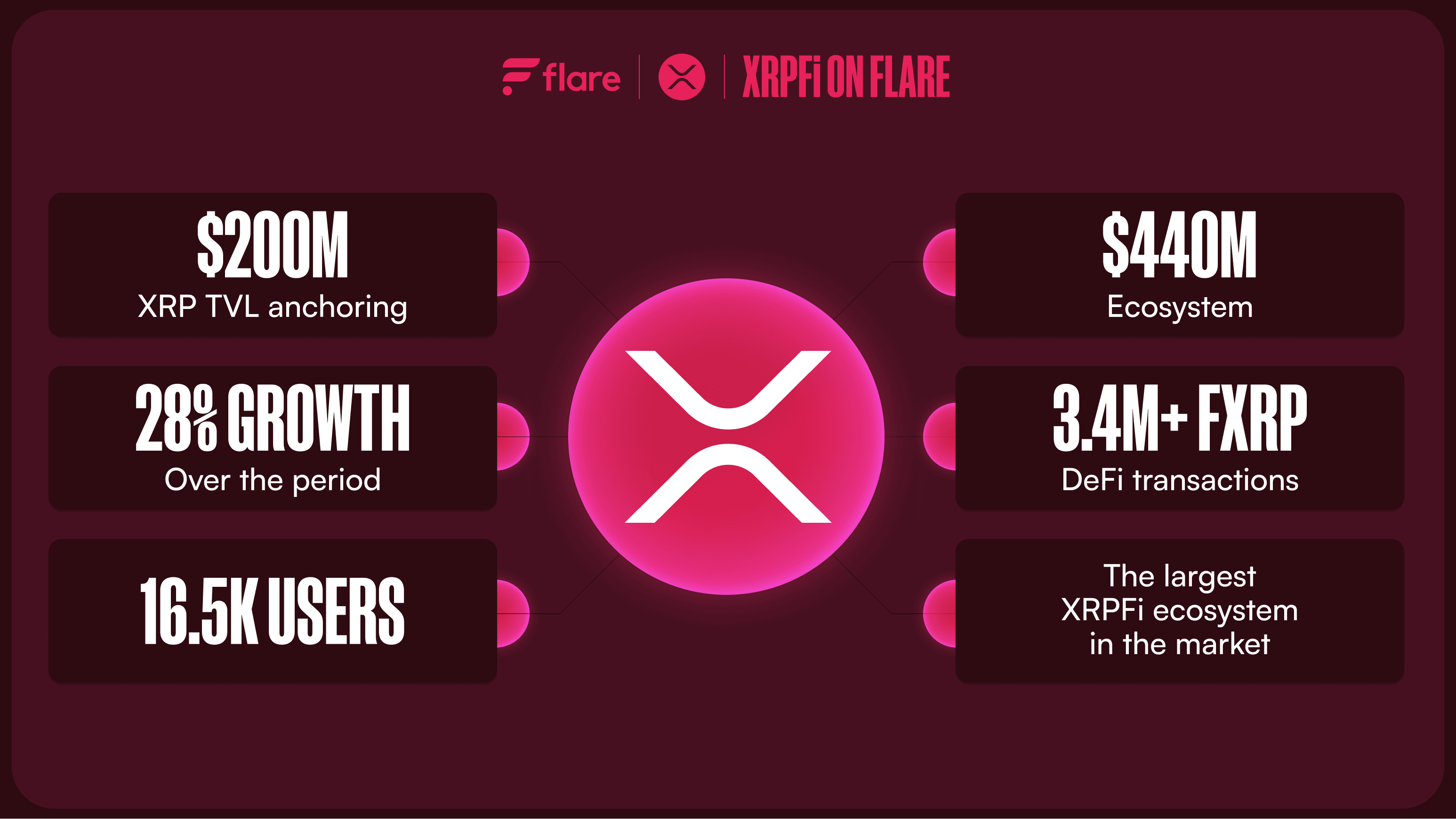
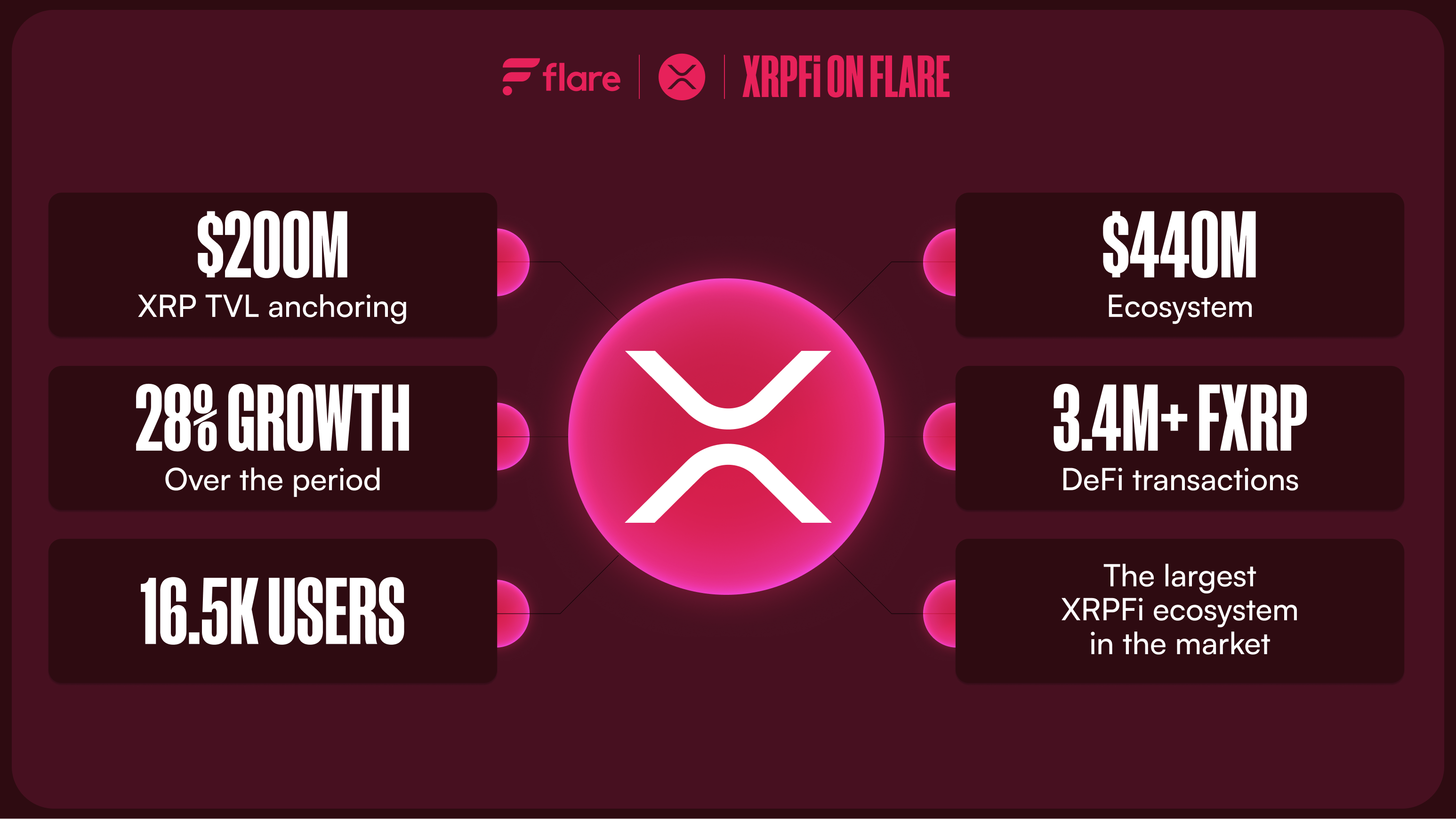
FXRP answered it. By bringing XRP onto Flare as active capital, it turned a held asset into one that could be deployed, lent, staked, traded, used as collateral, and routed into vault strategies. The first phase tested that thesis, and the numbers held up. Flare is now the largest XRPFi ecosystem in the market: ~$200M in XRP TVL anchoring a $440M ecosystem, 28% growth over the period, and 3.4M+ FXRP DeFi transactions across ~16.5K users since launch.
Capital moved. Markets formed. XRP started doing more than waiting.
The first phase proved the demand. The next phase is about scale — and three pieces of the stack are coming online to drive it.
What the first phase exposed
The first phase also showed where XRPFi needs to mature. UX is still fragmented. Vault capacity fills quickly and dilutes returns. Yield hasn't always felt strong enough to compete for attention. And distribution matters as much as protocol design — XRP holders shouldn't have to find their way to XRPFi; XRPFi should reach them.
These aren't reasons to doubt the thesis. They're the next set of problems to solve. Early infrastructure proves something can work; the next stage proves it can scale. That's what the upcoming launches are built for.
The next phase: three unlocks
The next phase targets the bottlenecks phase one exposed: strategy depth, distribution, and UX.
More vault choice
A new FXRP vault launches on Flare with a multi-strategy mandate that combines on-chain and off-chain return sources. It sets the template for what comes next: a broader menu of vaults on Flare across different risk profiles, curators, and yield mechanics, so XRP holders can match strategies to preferences instead of choosing the only option available. Some users want fully on-chain transparency. Others want managed exposure, liquidity-first designs, or more sophisticated returns. A real financial system needs all of them.
FAssets v1.3: direct minting
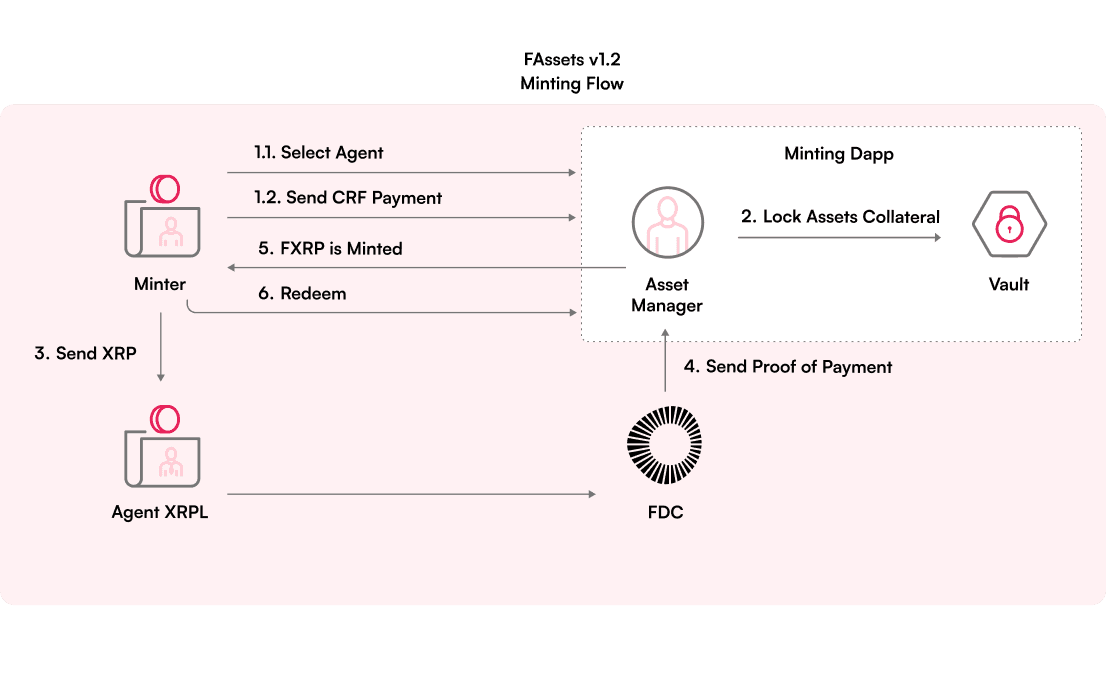
FAssets v1.3 upgrades the rails underneath FXRP. The core change is direct minting via XRPL destination tags: an XRP holder can send XRP from an XRPL address — including from exchange that allows destination tags — and have FXRP minted directly to a Flare address, without going through a separate bridge interface. Combined with decoupled minting capacity and additional safety controls, this is what makes exchange integrations possible at scale. v1.3 unlocks the next wave of integrations. Testing on Songbird is nearly complete, and mainnet launch is imminent.
A direct front end with Flare Smart Accounts
A standalone dApp lets XRP holders sign in directly from their XRPL wallet, deposit into FXRP vaults, and allocate to strategies in a single signature. Flare Smart Accounts handle the mechanics underneath — gas abstraction, XRPL-based signing, and transaction execution on Flare — so the user does not have to manage the bridging and approval steps that fragment most DeFi today. It supports multiple XRPL-native wallets, with one major partner live on day one and more to follow. This is the layer that turns XRPFi from a power-user surface into something the next wave of XRP holders can actually use.
Yield is the interface, not the product
It's tempting to reduce XRPFi to one number: the APY. That's the visible surface. Underneath are the things that make a financial system work — collateral, liquidity, credit, hedging, staking, structured products, risk transfer. If XRPFi is only a search for the highest short-term rate, it stays shallow. If it becomes a connected system where XRP can move between risk profiles and financial uses, it becomes something larger.
XRPL stays the asset and settlement layer. Flare provides the compute, data, and execution layer. XRP has been awakened. Now it gets the distribution.
Why this matters
Practical context for the Flare ecosystem.
For users
More vault options and a single‑click XRPL‑wallet dApp lower friction for XRP holders, potentially expanding the active user base beyond current power‑users.
For builders
FAssets v1.3’s direct‑mint bridge opens a clearer integration path for exchanges and wallet providers; Flare Smart Accounts offer a reusable gas‑abstraction layer for future dApps.
For the network
Additional vaults and higher minting capacity increase on‑chain activity on Flare, reinforcing its role as the compute layer for XRP‑based finance.
FTSOBest analysis
Confirmed facts
- FXRP is the representation of XRP on Flare and is already being used for lending, staking, collateral, and vault strategies.
- Current metrics (as quoted by Flare): ~$200 M in FXRP TVL, anchoring a $440 M ecosystem, 28 % growth since launch, 3.4 M+ FXRP DeFi transactions by ~16.5 K users.
- Phase 1 revealed three friction points: fragmented UX, limited vault capacity, and yield perception.
- Phase 2 introduces three components:
- New FXRP vault with a multi‑strategy mandate (on‑chain + off‑chain sources) intended as a template for a diversified vault menu.
- FAssets v1.3 – direct minting of FXRP using XRPL destination tags, removing the separate bridge UI; testing on Songbird is near‑complete and mainnet launch is described as “imminent”.
- Standalone dApp with Flare Smart Accounts – users can sign in with XRPL wallets, deposit to vaults and allocate strategies in a single signature. The dApp abstracts gas, handles XRPL‑based signing, and currently has one major partner live, with more to follow.
- XRPL remains the settlement layer; Flare provides compute, data, and execution.
Technical interpretation
- Direct minting (FAssets v1.3) eliminates the need for a user‑side bridging step, which should reduce latency and gas costs associated with moving XRP to Flare. By leveraging destination tags, the flow works with exchanges that already support tagged deposits, potentially enabling automated, high‑volume onboarding.
- Flare Smart Accounts implement gas abstraction and cross‑chain signing, meaning that XRPL‑native users no longer need a separate FLR‑address or hold FLR for gas. This design mirrors account abstraction concepts on other chains and could simplify future DeFi composability on Flare.
- Multi‑strategy vaults introduce diversified risk profiles. If on‑chain and off‑chain return sources are combined, the vault’s exposure will be broader, but it also adds operational risk (e.g., reliance on off‑chain yield providers). The architecture will likely require clear oracle and custody safeguards.
Dependencies
- Successful mainnet launch of FAssets v1.3 (currently “imminent”).
- Integration of exchange APIs that support XRPL destination tags for direct minting.
- Continued development and security audits of Flare Smart Accounts, especially around gas abstraction and signature verification.
- Availability of additional vault curators to populate the diversified vault menu.
Summary The announced upgrades aim to move XRPFi from a proof‑of‑concept stage to a more scalable, user‑friendly ecosystem. By simplifying the XRP‑to‑Flare bridge, adding diversified vaults, and providing a unified front‑end with gas‑abstraction, the stack addresses the three pain points identified after phase 1. The actual impact will depend on the timing of the mainnet release, the breadth of exchange and wallet integrations, and the robustness of the new vault and Smart Account implementations.
Ratings
Comments
Connect your wallet to leave a comment.